OverviewChallengeHealthcare ContextMethodsFindingsRecommendationsClinician StudyMeasurementFull Paper
Back to all work
Case Study · 05 of 06

Care Navigation & Clinician Workflow

Two sides of the same system. How patients find trustworthy local care during a public health emergency — and how physicians document that care inside the EMR/EHR. A 12-week mixed-methods program that ended in a 23% satisfaction lift and a prioritized set of workflow fixes for the clinical floor.

Domain
Healthcare · Digital Health
Role
Lead Researcher
Evidence
122 surveyed · 9 interviewed
Clinical setting
Hospital contextual inquiry · Dearborn, MI
Outcome
+23% user satisfaction
Survey (n=122)In-depth interviewsContextual inquiryUsability testingRITE testingCompetitive analysisInformation architecturePersonasThematic analysis
My Role

Lead Researcher across both studies — study design, survey instrument, moderation of all interviews and usability sessions, hospital fieldwork, synthesis, and the recommendations handed to the team of seven cross-functional collaborators.

Two audiences, one system

Most healthcare studies pick a side. This one covered both: the patient trying to locate care, and the physician documenting it. The friction each group experiences is produced by the same information system.

Access & compliance

Clinical fieldwork ran inside a working hospital under clinician supervision, with supervised PHI exposure and adherence to the supervising physician's protocols. All research was conducted under academic oversight.
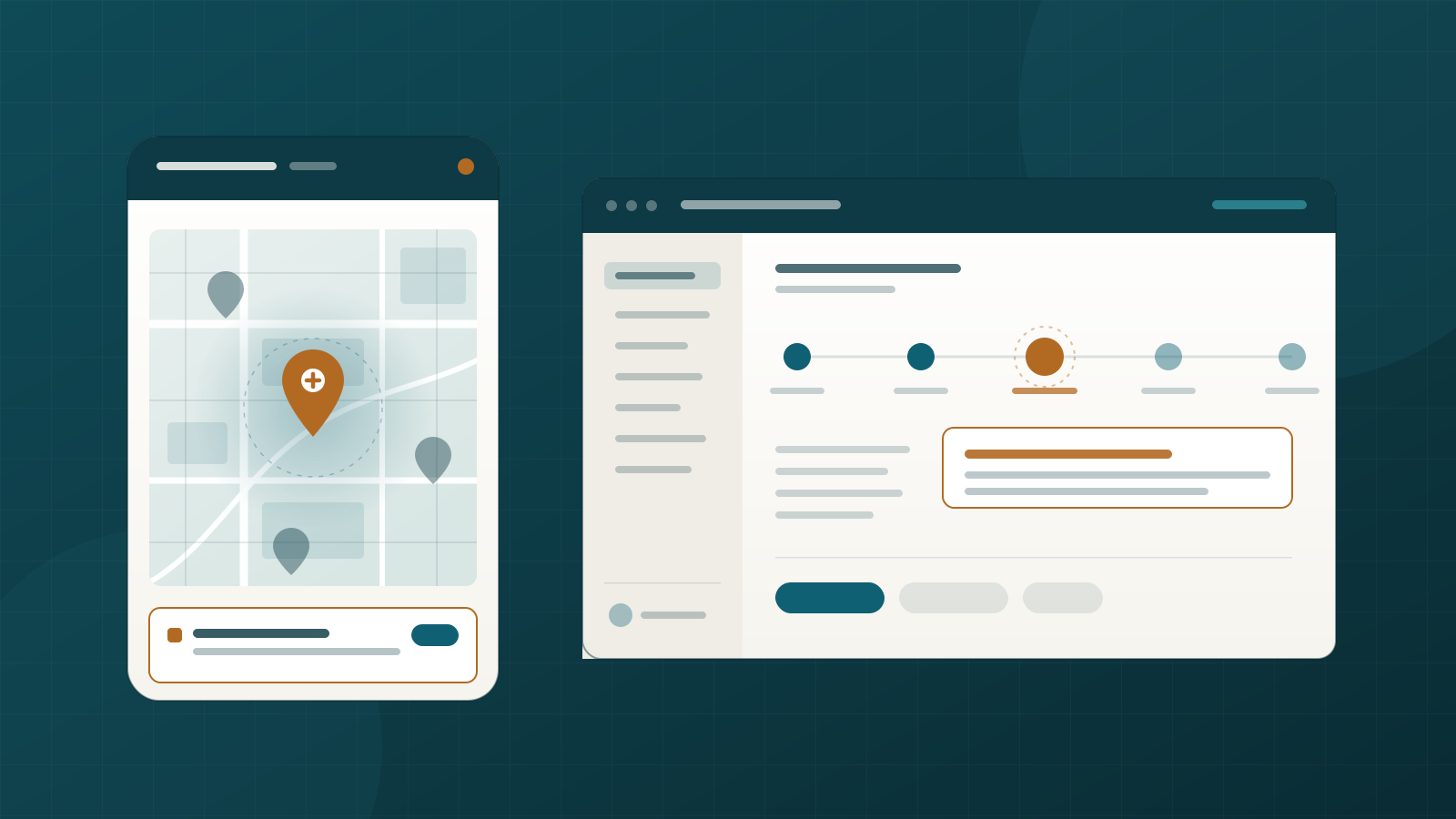
Two research surfaces side by side — a patient-facing care navigation map with clinic pins and a highlighted recommended provider, and a clinician-facing electronic health record panel with a friction point marked in the documentation workflow.
Outcome

Research-informed redesign, measured.

↑23%
Reported user
satisfaction
122
Survey respondents
(baseline behavior)
9
In-depth interviews
(mental models & trust)
The Challenge

People could find information. They couldn't find care.

During the COVID-19 pandemic, people seeking health services hit real barriers to timely, accurate, localized guidance on testing, treatment, and prevention — barriers with the potential to delay care and increase health risk.

A competitive review of peer applications showed the market was saturated with breadth of information and empty of local awareness. Every competitor could tell you what COVID-19 was. None could reliably tell you where to go tonight, whether that clinic had capacity, and whether the recommendation could be trusted.

The opportunity was a trustworthy digital tool that recommends nearby clinics and hospitals and surfaces credible local guidance — reducing time-to-care and improving patient confidence in the information presented.

Peer applications provided extensive information but did not integrate map-based, real-time local awareness — the primary unmet need surfaced by patients.

Healthcare Context

What makes healthcare research different.

Health research is not consumer research with a medical skin. Access is gated, data is protected, the user is rarely one person, and the cost of a bad information architecture is measured in delayed care rather than abandoned carts.

Those constraints shaped every method decision in this study — who could be recruited, what could be recorded, where sessions could be held, and how findings had to be framed for clinical stakeholders who scrutinize evidence for a living.

Protected health information

Hospital observation involved supervised PHI exposure. Fieldwork followed the supervising clinician's protocols, and synthesis preserved patient privacy — no identifiable detail left the floor.

Gated clinician access

Physician time is the scarcest resource in healthcare research. Sessions were designed around live documentation work rather than pulling clinicians into a lab, so observation cost them no additional time.

Multi-stakeholder reality

Patients, physicians, and the operational layer between them experience the same system differently. Findings were segmented by audience so no group's needs were averaged away.

Evidence built to be challenged

Clinical stakeholders interrogate methodology before conclusions. Sample, method, and limitation were documented alongside each finding — including a formal written paper.

Trust as a design variable

In health contexts, credibility of the source determines whether a recommendation is acted on. Trust signals were treated as a first-class research question, not a visual polish item.

Consumer expectations, clinical stakes

Patients bring expectations set by consumer apps into a regulated environment. The work sits where healthcare marketing and consumer digital innovation meet.

Objectives

Four questions, two populations.

Methods

A mixed-methods evidence base.

Generative work established what people needed and believed; evaluative work tested whether the product delivered it. Each method was selected to answer a question the others couldn't.

Table 1 · Research methods and evidence base
MethodSamplePurpose
Surveyn = 122Establish baseline needs, information-seeking behavior, and provider-selection preferences.
In-depth interviewsn = 9Explore mental models, trust signals, and decision drivers when locating care.
Usability testingIterative roundsEvaluate task success and comprehension of the prototype.
RITE testingIterative roundsRapidly iterate on interface changes between sessions.
Competitive analysisPeer applicationsIdentify market gaps and points of differentiation.
Contextual inquiryPhysicians · Dearborn, MI hospitalObserve EMR/EHR use in a clinical setting under supervised PHI exposure.
Key Findings

Architecture, not features, decided the outcome.

The product had the information people needed. What it lacked was a structure that let them act on it.

01

Information architecture was the principal barrier to patient decision-making

Iterative usability and RITE testing showed users could not reliably determine which providers the tool was recommending — the central decision the product existed to support. Every downstream feature depended on a judgment people could not make.

02

The map interface was central to the value proposition and insufficiently discoverable

The real-time local awareness that differentiated the product from every competitor sat below the fold. Users rarely scrolled far enough to encounter it during initial sessions, so the one advantage the product had went unseen.

03

Labeling and terminology introduced misinterpretation

Several terms carried unintended meaning for participants and shaped how they evaluated their care options. In a health context, a misread label does not just confuse — it redirects a care decision.

04

Interaction affordances were unclear

Drag-and-drop behavior was not visually evident, which interrupted task completion. Participants stalled on mechanics rather than the decision the mechanics were meant to serve.

05

The competitive gap presented a clear differentiation opportunity

Peer applications provided extensive information but did not integrate map-based, real-time local awareness — the primary unmet need surfaced by patients, and the strategic position the product could own.

Recommendations

Insight → recommendation → observed outcome.

Findings were translated into design and workflow recommendations, then re-tested. The cumulative impact of the research-informed redesign was a 23% improvement in reported user satisfaction.

Table 2 · Insight, recommendation, and observed outcome
InsightRecommendationOutcome
Users could not identify recommended providers.Visually distinguish recommendations; add persistent home and back navigation.Validated in RITE re-testing; reduced confusion.
The map was discovered too late in the session.Surface the real-time map tracker above the fold.Improved discovery of the core value proposition.
Terminology was misread.Rewrite copy against users' mental models.Clearer comprehension in follow-up testing.
Weak interaction affordances.Make interactions explicit and visually discoverable.Smoother task completion.
Companion Study

Inside the EMR/EHR, with the clinicians who live in it.

A companion contextual inquiry was conducted with physicians at a hospital in Dearborn, Michigan, with supervised protected health information exposure.

The objective was to observe how clinicians work within the electronic health record during patient documentation, and to identify the sources of friction that accumulate across a shift. Observations were synthesized into prioritized recommendations intended to streamline clinical documentation and reduce provider burden.

Fieldwork adhered to the supervising clinician's protocols and preserved patient privacy throughout. The methodological point matters as much as the findings: documentation burden is invisible in interviews and self-report. It only shows up when you watch the work happen.

The patient couldn't find the provider. The physician couldn't finish the note. Both are information architecture problems.

Measurement Framework

From a one-time study to an ongoing insights practice.

A study answers a question once. Instrumentation answers it continuously. To translate these findings into an ongoing insights and measurement practice for marketing and consumer digital innovation stakeholders, the following instrumentation was proposed.

Full Paper

The complete written case study.

The full research write-up — abstract, methods table, findings, recommendations, companion clinical study, and the proposed measurement framework — documented in the format clinical and academic stakeholders expect.

PDFHealthcare Marketing Research & Insights Case Study — Eunji (Estele) Kim2 pages
Healthcare Marketing Research & InsightsThe full two-page written case study, including both research tables and the proposed measurement framework. Best read full-screen.
Open the full paper (PDF)DownloadGraduate research, M.S. Human Centered Design & Engineering · conducted under academic supervision
Reflection

What I'd carry into a health team.

Rigorous mixed-methods research surfaced actionable, quantified findings for both patients seeking local care and clinicians working inside the EMR/EHR. The recommendations delivered a measurable improvement in patient-facing satisfaction and a defensible set of workflow priorities for the clinical setting.

The durable lesson was that information architecture — not feature count — determined whether people could act on what the product recommended. That holds on both sides of the system: the patient scanning for a provider and the physician hunting for the right field are performing the same task in different clothing.

Given more time, I'd stand up the proposed measurement framework and run it continuously: task success, time-to-locate-care, funnel drop-off, and satisfaction trends with significance testing on pre/post changes, reported into a standing dashboard. That converts a one-time study into the kind of ongoing analytics practice a healthcare marketing and consumer digital innovation team can steer by.